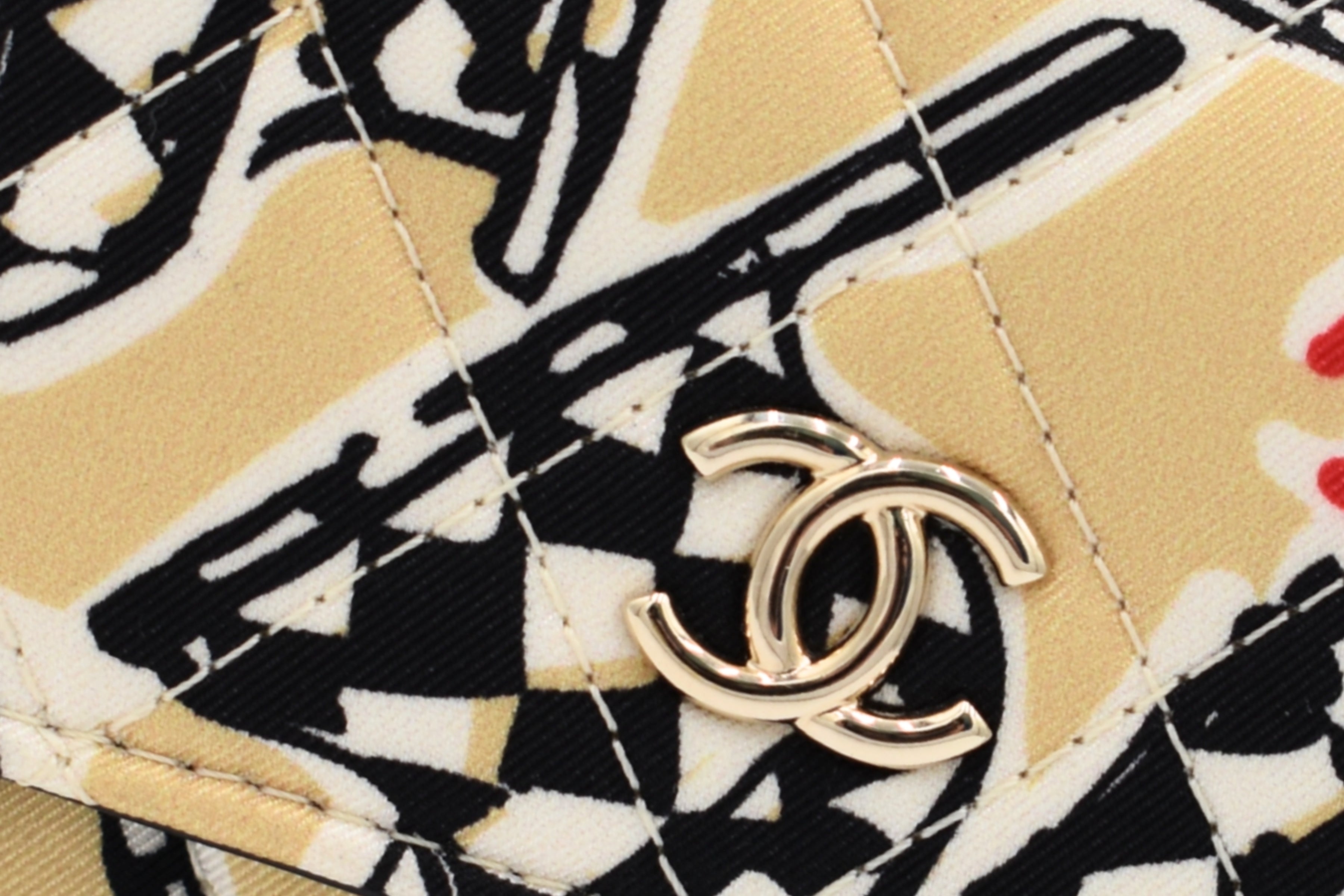
Chanel: A Story About Reinvention
There is a certain kind of power that announces itself quietly. Chanel has always understood this.
Gabrielle Bonheur Chanel was born in 1883 in a Saumur poorhouse, a fact she spent her lifetime rewriting. She preferred a different story: a different city, a different year, a different family altogether. What she could not rewrite was the orphanage at Aubazine, where she was sent at twelve after her mother died and her father disappeared into the road. The nuns taught her to sew. The stone corridors, the geometric stained glass, the burgundy of the uniforms worn there, all of it stayed with her, surfacing decades later in the lining of a bag, the quilting on a flap, the quiet codes of a house that would one day be worth billions.
She arrived in Paris in 1910 with very little and opened a millinery shop at 21 rue Cambon. What she had, beyond talent, was a singular conviction: that women had been dressed, for too long, by people who did not trust them to move.
She dismantled the corset. She put women in jersey, in trousers, in the little black dress that Vogue would call, in 1926, the Ford of fashion. She introduced the tan as an aesthetic after stepping off a yacht with sun-bronzed skin and simply refusing to apologize for it. Every gesture was an argument. Every silhouette, a position.
In February 1955, at seventy-one, she designed a bag.
The 2.55 is named for its birth month and year, with the kind of cool practicality that was always distinctly hers. Before it existed, women carried their bags in their hands or under their arms, both hands never free, always occupied. Coco added a chain. The gesture was small. The implications were not.
Look closely at the interior and you find a woman's entire philosophy rendered in compartments. The lining in Aubazine burgundy. A pocket for a lipstick. A pocket for coins. A small inner pocket, legend holds, for love letters. And a front pocket for cash, so a woman would never have to ask a man for money. The clasp she called the Mademoiselle lock, after her own unmarried status, worn without apology for her entire life. She was proud of it. She put it on the bag.
When Karl Lagerfeld relaunched the house in 1983, he introduced the Classic Flap, a variation with a double CC turn-lock and a refined chain. The two bags occupy different registers of devotion among those who care about such things, which is to say, among a very specific and very serious type of person. Both trace their lineage to the same premise: a woman, her hands free, moving through the world on her own terms. A Classic Flap in caviar leather now commands upward of ten thousand dollars on the resale market. In 2021, Chanel raised prices three times. The medium beige flap has quietly outperformed certain asset classes. Coco, who was born with nothing, would have appreciated that.
During the Nazi occupation of Paris, she moved into the Hotel Ritz, took a German officer as a lover, and by declassified account worked as an intelligence asset under the code name Westminster. She was arrested after the liberation of Paris and released quickly, possibly through the intervention of Winston Churchill, then fled to Switzerland. She returned in 1954, relaunched the house at seventy, and was received with open arms in America while Paris stayed cold. She said nothing about any of it. Neither has the house.
Lagerfeld's era was, by contrast, impossible to ignore. He sent collections down runways built to resemble supermarkets and rocket launchpads. He put the CC logo on surfboards and sequined boxing gloves. He owned a library so vast it filled an entire building and slept, by his own account, no more than five hours a night. He designed until months before his death at eighty-five in 2019. He was brilliant and difficult and sometimes cruel, particularly on the subject of bodies, and all of it is part of the record.
After him came Virginie Viard, quiet and interior where Karl had been spectacle, her collections rooted in a personal, wearable France. She stepped down in 2024.
In February 2025, Matthieu Blazy took the house. He had made his name at Bottega Veneta on the radical idea that luxury should be felt before it is seen, that a white t-shirt in the finest leather was more subversive than any logo. His debut at Chanel honored the boucle and the camellia and the chain while returning to something older and more essential. Critics called it a reawakening. What Blazy understands, and what Coco understood a century before him, is that the most powerful thing a garment can do is disappear into the woman wearing it, leaving only her.
That has always been the Chanel argument. It has survived wars and exile and reinvention and the particular cruelty of fashion's long memory. It survives still.